

CT Imaging
Advanced Technology. Detailed Views. Personalized Care
Computed tomography, commonly called a CT or CAT scan, uses advanced X-ray technology and sophisticated computer processing to create clear, detailed cross-sectional images of the inside of your body.
CT scans allow your care team to evaluate organs, blood vessels, bones, and soft tissues in fine detail providing important answers to diagnose medical conditions, guide treatment, and monitor your overall health.
Why Choose CT Imaging?
- Exceptional detail: Captures high-resolution 3D views of bone, soft tissue, and blood vessels simultaneously.
- Fast and comfortable: Most scans take only a few minutes to complete.
- Noninvasive precision: Provides clear diagnostic answers as an outpatient procedure.
- Low-dose commitment: Advanced equipment calibrated to use the lowest reasonably achievable radiation dose.
Explore Our CT Imaging Services
Cardiac & Heart Imaging
- Coronary Artery Calcium Scoring CT: A quick, contrast-free scan that measures calcified plaque to evaluate your overall heart disease risk.
- Coronary Artery CT Angiogram (CCTA) with HeartFlow™: Detailed 3D imaging of heart arteries and plaque, featuring advanced HeartFlow™ blood-flow analysis without extra radiation.
Preventive Screening
Low-Dose CT Lung Cancer Screening: An annual, needle-free screening for eligible high-risk patients designed to catch subtle lung changes early, when treatment is most effective.
Diagnostic Body & Neurological Scans
- Brain, Head & Neck CT: Evaluates neurological health, persistent headaches, sinus issues, and facial bone structures.
- Accordion: Chest CT: Examines lung tissue, airways, lymph nodes, and surrounding chest structures.
- Abdomen & Pelvis CT: Provides detailed views of internal organs, including the liver, kidneys, pancreas, spleen, and digestive tract.
- Spine, Bone & Joint CT: Assesses complex bone fractures, joint health, arthritis, and spinal alignment.
Vascular Imaging (CT Angiography / CTA)
CT Angiography (CTA): Uses IV contrast to create clear 3D images of blood vessels throughout your body, helping doctors check for blockages, aneurysms, or narrowing in the neck, aorta, legs, or kidneys.
What to Expect During Your CT Exam
A Comfortable, Open Design
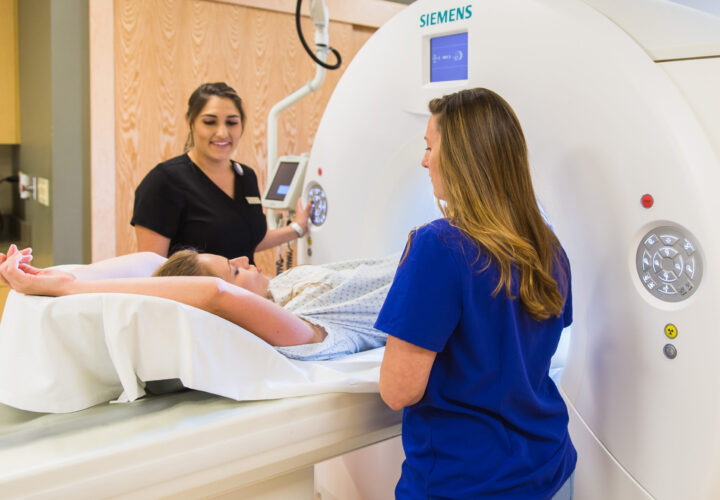
- Open Ring Design: A CT scanner is shaped like a large, open ring rather than a long, enclosed tunnel.
- Painless & Fast: You lie on a comfortable table that moves smoothly through the ring while taking images.
- Holding Your Breath: You may be asked to hold your breath for a few seconds to ensure images remain crisp and clear.
Understanding CT Contrast
Why Contrast Material Is Used. Some CT scans use intravenous (IV) contrast material to highlight blood vessels, organs, and tissue structures for clearer viewing.
- How It Feels: If contrast is needed, a small IV is placed in your hand or arm. You may feel a temporary warm sensation or a mild metallic taste, which passes quickly.
- Important Safety Checklist: Before receiving contrast, please let our imaging team know if you:
- Have had a previous reaction to CT contrast material.
- Have significant kidney disease or a history of kidney problems.
- Take medications requiring special instructions (such as certain diabetes medications).
- Are or may be pregnant.
Our Commitment to Radiation Safety
Your safety is our top priority. Our imaging team tailors every examination to use the lowest radiation dose reasonably achievable while obtaining the high-quality diagnostic information your doctor needs. Specialized exams like low-dose lung cancer screening and calcium scoring are designed specifically for reduced radiation exposure.
Clear Insights for Your Heart Health
Heart disease can develop gradually over time, often without noticeable symptoms. Our advanced cardiac imaging services provide detailed, noninvasive views of your heart and coronary arteries—the blood vessels that supply oxygen-rich blood to your heart muscle.
Whether you need a quick risk screening or a detailed evaluation of chest discomfort, our specialized imaging technologies give your healthcare team accurate answers to guide your personalized care.
Why Choose Advanced Cardiac Imaging?
Cardiac imaging allows your doctor to evaluate your heart with precision and comfort:
- Detect heart disease early: Identifies plaque buildup in coronary arteries before symptoms arise.
- Evaluate artery narrowing: Shows whether arteries are open or narrowed by plaque.
- Assess blood flow impact: Determines whether arterial narrowing restricts blood flow to your heart muscle.
- Guide personalized prevention: Helps your care team tailor lifestyle recommendations or medications to your specific needs.
Explore Our Cardiac Imaging Services
Select a service below to learn more about how we evaluate your heart health:
- Coronary Artery Calcium Scoring CT: A quick, contrast-free scan measuring calcified plaque to assess overall heart disease risk.
- Coronary Artery CT Angiogram (CCTA) with HeartFlow™: Detailed 3D imaging of heart arteries and plaque, featuring advanced HeartFlow™ blood-flow analysis without additional radiation.
- Stress Cardiac MRI: Radiation-free MRI imaging that evaluates heart muscle function, structure, and blood flow under simulated stress conditions.
Coronary Artery Calcium Scoring CT
A Coronary Artery Calcium (CAC) score is a quick, noninvasive CT scan that measures calcified (hardened) plaque in the arteries supplying blood to your heart. Plaque buildup is a key sign of coronary artery disease, and a calcium score provides valuable risk information even if you have no symptoms.
Who Should Consider Calcium Scoring?
Your doctor may recommend a calcium scan to help guide preventive heart decisions if you have risk factors such as:
- High cholesterol or high blood pressure
- A family history of heart disease
- Diabetes or a history of smoking
- Uncertain overall cardiovascular risk
What to Expect During Your Calcium Scan
- No IV or contrast required: The scan requires no needles.
- Quick and painless: Takes only a few minutes and uses a low dose of radiation.
- Simple preparation: Small monitoring pads are placed on your chest to coordinate imaging with your heartbeat while you hold your breath briefly.
Understanding Your Calcium Score
Your scan produces a numerical score reflecting the total amount of calcified plaque in your heart arteries:
- Score of 0: No calcified plaque was detected (indicating low immediate risk, though soft plaque can still exist).
- Higher Score: Indicates a greater amount of calcified plaque buildup and a higher risk of heart disease.
- Next steps: Your doctor will review your score alongside your personal medical history to recommend the best preventive steps for you.
Coronary Artery CT Angiogram (CCTA) including HeartFlow™
A Coronary CT Angiogram (CCTA) is an advanced, noninvasive imaging examination that provides detailed 3D pictures of your coronary arteries. While a calcium score measures hard calcium only, CCTA identifies both soft (noncalcified) and hard plaque, evaluating areas where arteries may be narrowed.
Why Is a CCTA Recommended?
Your healthcare provider may order a CCTA to:
- Detect coronary artery disease and locate plaque buildup.
- Evaluate the location and severity of artery narrowing.
- Investigate causes of chest discomfort or unexplained symptoms.
- Determine if further cardiac testing or treatment is needed.
What to Expect During Your CCTA
- IV Contrast: A small IV is placed in your arm to deliver contrast material so your coronary arteries show up with sharp clarity on the scan. You may feel a brief warm sensation.
- Heart Rate Optimization: Chest pads monitor your heart rate, and you may receive temporary medication to gently slow your pulse for the clearest possible pictures.
- Quick Scan: You will be asked to hold your breath briefly while the scanner captures images in just a few seconds.
Advanced Analysis Options (no additional scan required)
- Quantitative Coronary Plaque Analysis
Using specialized computer software, your CCTA images can be analyzed to measure total plaque volume, plaque types (soft vs. hard), and plaque distribution throughout your arteries.
- No additional scan or radiation: Uses the CCTA images already taken—requiring no additional contrast or exposure.
- HeartFlow™ Analysis (FFRCT – Fractional Flow Reserve derived from CT)
When CCTA identifies narrowing in an artery, HeartFlow™ AI analysis creates a personalized 3D model of your heart to estimate whether that narrowing actually reduces blood flow to your heart muscle.
- Functional clarity: Helps your cardiologist determine if a blockage is significant enough to require invasive procedures or if medical management is best.
- No additional radiation or scans: Performed entirely using your existing CCTA scan data.
Cancer Screening Low-Dose CT Lung Cancer Screening
Finding lung changes early, when care Is most effective
lung cancer screening with low-dose CT (LDCT) is designed to detect lung cancer at an early stage, often before any noticeable symptoms develop